
Views: 0 Author: Site Editor Publish Time: 2026-10-07 Origin: Site


Have you ever stood before a tough excavation project, wondering if any rotating drill will get the job done? Buyers often assume a motorized or manual auger works universally for both soil excavation and ice drilling. This common misconception frequently leads to costly mistakes on the job site.
Clarifying the structural differences between these tools is absolutely vital. Choosing the correct auger architecture prevents catastrophic blade damage. It also protects you from severe operator injury caused by sudden torque kickback. More importantly, selecting the proper equipment prevents frustrating project delays. Manufacturers engineer these tools for highly specific environments, and ignoring these engineering limits guarantees poor performance.
In this guide, we compare mechanical differences and highlight specific use cases to clear up the confusion. We evaluate interchangeability risks and lay out basic procurement logic. You will learn how to make an informed, application-specific decision before committing to your next equipment acquisition. You will know exactly which tool matches your specific terrain.
Blade Geometry is the Divider: Ground augers use aggressive, high-torque digging blades (often with a fishtail pilot); ice augers rely on precision shaver or chipper blades designed for high-RPM cutting.
Interchangeability is a Compromise: Using an ice auger in soil instantly destroys razor-sharp blades. Using a ground auger on ice creates jagged, dangerous holes and risks severe kickback.
Power Dynamics Vary: Soil excavation prioritizes raw torque for clearing rocks and roots; ice drilling prioritizes speed (RPM) for a clean breakout.
Procurement Logic: One-off fencing projects heavily favor rentals, while recurring seasonal tasks justify purchasing dedicated units.
Manufacturers build drilling equipment to conquer specific elemental challenges. Dirt and ice present entirely different forms of resistance. Therefore, engineers design tool components to match these distinct environmental demands.
The tip of your drill dictates how the entire operation begins. A ground auger utilizes a "fishtail" or heavy-duty pilot bit. This aggressive tip bites aggressively into compacted earth. It guides the main cutting edges downward through tough, uneven soil. The fishtail acts as a rugged anchor point. It prevents the drill from wandering when it encounters rocks.
Conversely, ice presents a slick, frictionless surface. An ice auger requires a specialized centering ring or a sharp centering point. This design prevents the tool from skipping across glare ice. If you apply a standard dirt pilot to smooth ice, it skates dangerously away from your target spot. The specialized ice point ensures perfectly vertical penetration.
Blade design separates these tools entirely. Ground auger blades consist of thick, highly durable steel. Manufacturers design them to survive blunt force impacts. They routinely strike buried rocks, dense clay, and thick tree roots. They do not rely on a razor edge. Instead, they use a scraping and gouging action to break up soil.
Ice auger blades take a completely different approach. They feature razor-thin, highly vulnerable shaver or serrated chipper edges. These blades shave microscopic layers of ice at high speeds. They require a surgical edge to function correctly. Even a minor scrape against dirt or gravel will instantly ruin them.
Powerheads distribute energy differently based on the required task. Soil excavation requires immense pulling power. Ground powerheads utilize lower RPM and high-torque gearboxes. They must pull heavy, dense material up the flighting without stalling the engine. High torque keeps the drill turning when it hits thick clay.
Ice drilling demands speed over raw force. Ice powerheads operate at a higher RPM with lower torque. They rely on rapid, frictionless penetration. Shaving ice requires fast rotation to eject slush efficiently. If an ice powerhead turns too slowly, it binds up and freezes inside the hole.
Design Specifications Comparison
Feature | Earth/Soil Models | Winter/Ice Models |
|---|---|---|
Pilot Tip | Fishtail or heavy-duty bite | Centering ring or sharp point |
Blade Style | Thick, impact-resistant steel | Razor-thin shaver or chipper |
Gearbox Focus | High torque, low RPM | Low torque, high RPM |
Primary Action | Gouging and heavy lifting | High-speed shaving and clearing |
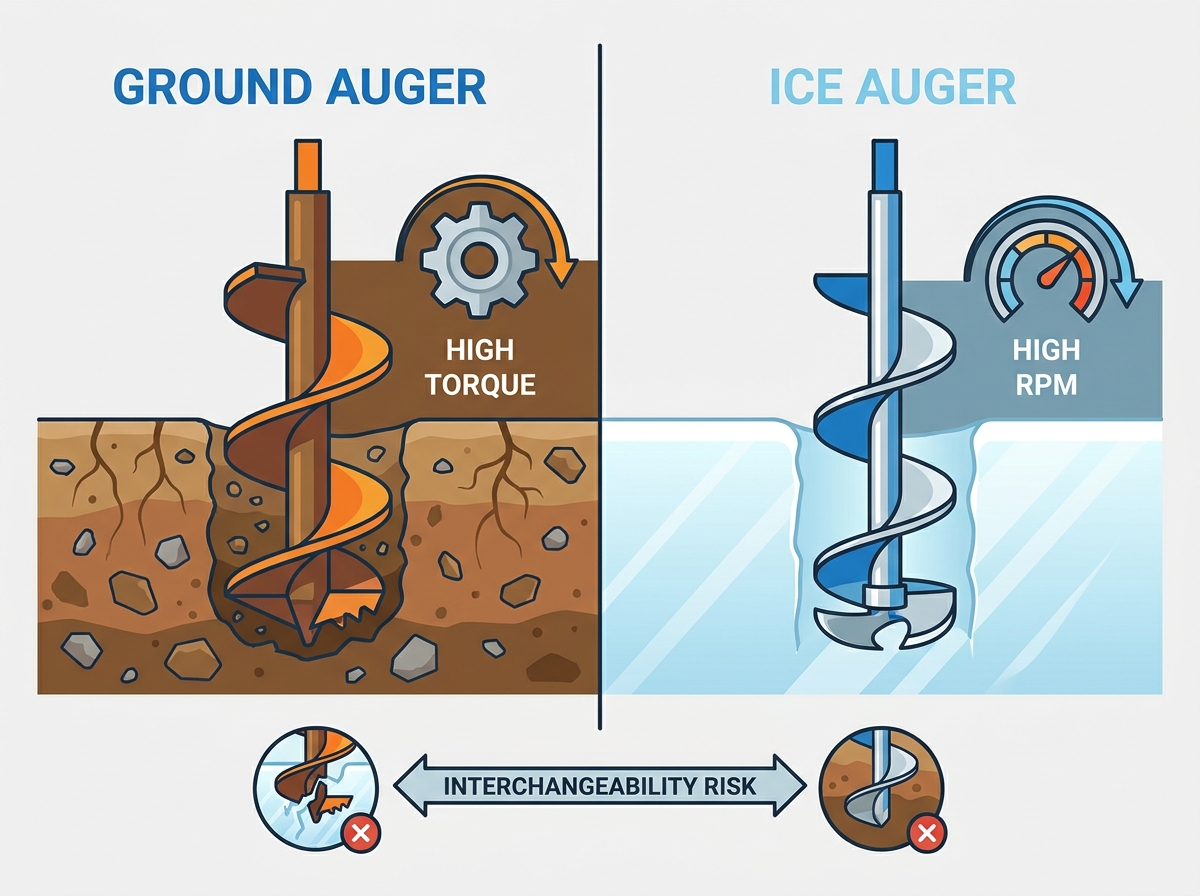
Theoretical mechanics translate into highly specific real-world results. You must match the tool to the intended environment to achieve success. Operating outside of these defined use cases leads to frustration and equipment failure.
Landscaping and construction demand rugged equipment. Common use cases include digging post holes, planting large trees, and installing fencing. Construction crews frequently use these tools to install a Ground Auger Anchor for structural tie-downs. This secures mobile homes, large tents, and retaining walls directly into the earth.
Standard models handle loose topsoil easily. However, demanding environments require upgraded power. You absolutely need a Heavy duty ground auger when dealing with heavy clay or rocky soil. These robust models push through deep frost lines. They handle extreme underground friction without snapping the drive shaft or burning out the clutch.
Winter applications present an entirely different set of performance realities. Hard water environments serve ice fishing and winter water sampling primarily. In these scenarios, the user requires a perfectly cylindrical, smooth hole.
A clean hole bottom is absolutely critical for ice fishing. We call this the "breakout." When the blade punches through the bottom of the ice sheet, it must do so cleanly. A jagged breakout creates sharp ice edges underneath the water. These sharp edges will easily fray and snap a fishing line during a prolonged catch. Ice models guarantee a smooth, frictionless edge to protect your gear.
Buyers frequently ask if they can purchase one machine to conquer all environments. The short answer is no. Attempting to force one tool into dual roles creates severe mechanical risks. It also endangers the operator.
Cross-application guarantees poor results. Let us examine what happens when you swap environments.
Earth to Ice: A dirt-focused tool will crush rather than cut the ice. This blunt-force approach leads to jarring kickbacks. It creates incredibly slow downward progress. You will end up with a jagged, irregular hole that actively damages fishing gear.
Ice to Earth: This mistake proves costly. Soil contact permanently dulls razor-sharp ice blades within seconds. A single buried pebble will chip the delicate edge. This instantly ruins an expensive, specialized component. You will be forced to buy replacement parts immediately.
Some manufacturers sell universal powerheads. They claim these units accept both dirt and ice flightings. While mechanically possible, you must evaluate the inevitable gearbox compromise. A universal engine cannot optimize two completely different tasks simultaneously.
If the powerhead optimizes for dirt, it spins too slowly. An ice flighting attached to a dirt gearbox will struggle to clear slush. Conversely, an ice-optimized powerhead lacks the necessary torque. If you attach a dirt flighting to an ice engine, it will bog down and stall in heavy clay. True efficiency requires a dedicated gearbox.
Engineers offer various power plants to match your project scale. Choosing the correct power source determines your fatigue levels and overall efficiency. You must scale the tool to the specific scope of your work.
Not every project requires a motorized engine. Minor landscaping benefits greatly from simpler tools. An Earth Auger Hand Tool serves perfectly for planting bulbs, installing small posts, or managing localized, soft-soil digging. It requires physical exertion but offers ultimate control and zero noise pollution.
Many homeowners prefer cordless drill attachments for small tasks. An Earth Auger for Drill connects directly to your standard garage drill. This setup proves highly viable for small holes measuring two to four inches in diameter. However, it carries significant risks for deep digging. Pushing a standard cordless drill into dense soil causes severe motor burnout. Furthermore, sudden binding can twist the drill violently, leading to painful wrist torque injuries. You must handle drill attachments with extreme caution.
Motorized units dominate heavy-duty tasks. The industry currently splits between traditional gas and modern battery power.
Gas Powered: Gas engines remain the traditional choice. They deliver maximum sustained torque. They perform flawlessly in remote locations where charging is impossible. However, they carry distinct liabilities. You must perform regular engine maintenance. You must mix fuel correctly. They also suffer from difficult cold-weather starting issues during freezing mornings.
Electric Powered: Lithium-ion technology disrupted the industry recently. Electric motors are rapidly becoming the absolute standard for ice drilling. They produce zero emissions. This allows safe operation inside enclosed ice shelters. They run incredibly quietly, which avoids spooking fish. They are increasingly viable for soil excavation too. However, extreme cold rapidly degrades battery life. You must actively manage battery temperatures to ensure consistent output.
Best Practices for Power Sources:
Keep lithium batteries inside a warm vehicle or insulated bag until immediately ready for use.
Always run premium, ethanol-free fuel in gas engines to prevent carburetor damage during off-season storage.
Never lock your wrist when using a cordless drill attachment; always utilize the auxiliary side handle.
Acquiring heavy equipment requires strategic thought. You must determine if your project justifies a permanent purchase. Let the frequency and scale of your tasks guide your ultimate decision.
Renting solves immediate, short-term problems. You should calculate the true return on investment for a Ground auger Rental. Renting proves ideal for finite, weekend projects. If you plan to build a single backyard deck or install one property line fence, renting makes perfect sense.
Renting removes long-term burdens. You avoid the headache of storing bulky equipment in your garage. You also skip the complex off-season maintenance routines. The rental yard ensures the machine runs perfectly before you pick it up. Once you finish digging, you simply return it and walk away.
Frequent usage completely changes the acquisition logic. You should look for a Ground auger for sale when your projects become recurring. Professional landscaping crews naturally require permanent ownership. Agricultural property management also demands having tools ready at all times.
Ownership benefits anyone with seasonal routines. If you manage extensive acreage, you will constantly fix fences and plant trees. Owning a dedicated Ground Auger allows you to work on your own schedule. You never have to rush to beat a rental yard deadline. You gain total operational freedom.
Understanding the mechanical boundaries of drilling tools prevents costly mistakes. While certain universal powerheads exist, the functional reality remains strict. The auger bits, flighting designs, and cutting blades are strictly application-specific. Forcing one tool to perform outside its engineered environment leads to broken gear and potential injury.
Before beginning your next project, follow these simple next steps:
Audit your soil type thoroughly to determine if you need heavy-duty capability.
Assess the actual frequency of your digging needs to decide between renting and buying.
Choose the specialized blade geometry that precisely matches your primary environment.
Prioritize dedicated gearboxes over universal kits to ensure maximum safety and operational efficiency.
A: Yes, you can drill through frozen earth. However, it requires highly specialized hardware. You must use carbide-tipped dirt blades or dedicated frost teeth. Standard earth blades will fail against frozen topsoil. You absolutely cannot use standard ice blades, as frozen dirt will instantly destroy their razor-thin edges.
A: Yes, they absolutely do. Extreme cold physically limits lithium-ion power output. Freezing temperatures reduce the overall runtime significantly. Ice anglers must keep their spare batteries heavily insulated. Keep them inside a heated shelter, a warm vehicle, or close to your body before actual use.
A: Ice blades are incredibly delicate. They may require seasonal replacement or precise professional sharpening. If they accidentally touch bottom debris or sand, they dull instantly. Conversely, dirt blades act as blunt-force scraping tools. They last significantly longer and only require replacement if heavily abused by massive rocks.


