
Views: 0 Author: Site Editor Publish Time: 2026-10-21 Origin: Site


Entering the hardware aisle feels overwhelming today. Countless brands promise unmatched power and runtime. You might wonder which tool genuinely delivers. Buyers face a tough dilemma because market saturation makes choosing battery-powered tools confusing. You are not just choosing a drill; you are committing to a proprietary battery ecosystem. Picking the wrong platform leads to expensive replacements later.
Our transparent evaluation focuses on torque-to-weight ratios, real-world runtime under load, and chuck durability. We ignore hyped maximum RPM claims to bring you verifiable facts. Long-term battery cycle life dictates our recommendations. We want to provide a hype-free, use-case-specific comparison. This guide helps you select the exact tool matching your daily workload and budget limits.
Best Overall for Professionals: High-voltage (18V/20V) brushless models offer the highest sustained torque for heavy-duty contracting and masonry.
The 12V Reality: Modern 12V platforms frequently match older 18V output, making them the optimal choice for overhead work and tight spaces.
Ecosystem Matters Most: The true cost of a tool lies in battery replacements and cross-tool compatibility.
Motor Type Dictates Lifespan: Brushless motors are universally recommended over brushed alternatives for decision-stage buyers prioritizing longevity and battery efficiency.
Marketing departments love to showcase peak performance numbers. Real-world applications demand entirely different metrics. Discovering the Best lithium ion drill requires looking past the packaging. You must evaluate how the tool performs under continuous stress.
Peak torque only lasts for a fraction of a second. It happens right before the motor stalls. Sustained torque matters significantly more for daily use. Sustained torque allows you to push a long auger bit through dense wood. It prevents the motor from bogging down during heavy tasks.
Chuck quality serves as a reliable indicator of overall durability. The chuck holds your drill bits securely. Cheap models use plastic chucks. Plastic components warp under heat and lose their grip over time. Professional models use all-metal ratcheting chucks. A metal chuck ensures superior bit retention. It prevents your expensive bits from slipping during high-torque applications.
You must choose between brushless and brushed motors. Brushless technology dominates the modern tool market for a reason. Brushed motors rely on carbon brushes causing internal friction. This friction generates excess heat and wastes battery power.
Brushless tools run noticeably cooler. Evidence shows they extend battery life by up to 50% per charge. They contain fewer wearable parts inside the housing. A brushless motor communicates electronically with the battery. It adjusts power output based on resistance. This smart communication protects the internal components from premature failure.
Power means nothing if the tool causes severe strain. Weight distribution plays a crucial role in daily comfort. A standard Cordless lithium ion drill feels light on the display shelf. However, adding a heavy 5.0Ah battery completely changes its balance.
Poorly balanced tools pull your wrist downward. This imbalance creates micro-tears in your forearm muscles over an eight-hour shift. Superior tools center the weight directly over the handle grip. This design minimizes wrist fatigue during extended overhead use.
Common Mistakes to Avoid:
Buying a drill based solely on maximum RPM.
Ignoring the weight of the battery pack during purchase.
Settling for a plastic chuck to save a few dollars.
We structured our top recommendations around specific buyer archetypes. Each category highlights transparent pros and cons. We base these evaluations on verified performance limits. This approach ensures you find a tool matching your exact operational reality.
Drill Archetype Comparison Summary
Model Archetype | Primary Target Use | Key Advantage | Notable Trade-off |
|---|---|---|---|
Heavy-Duty Contractor | Masonry, heavy framing | Maximum sustained torque | Heaviest weight class |
Advanced 12V Compact | Cabinetry, HVAC install | Exceptional ergonomics | Lower continuous Ah capacity |
Prosumer All-Rounder | Home renovation, auto repair | High value-to-feature ratio | Potential plastic components |
High-Torque Specialist | Plumbing/electrical rough-in | Unmatched low-speed power | Highly niche application |
Budget Ecosystem Entry | Facility maintenance | Broadest tool compatibility | Lacks premium smart features |
Target Use: Masonry work, heavy residential framing, and running large hole saws through thick materials.
Evaluation: This category demands extreme durability. We focus on advanced anti-kickback technology. Anti-kickback sensors detect sudden rotational shifts. They instantly shut down the motor if the bit binds. This feature protects your wrist from serious injury. We also look for an all-metal transmission and superior heat dissipation vents. These elements allow the tool to survive continuous concrete drilling.
Trade-off: This represents the heaviest option available. Using this tool for extended overhead tasks causes rapid shoulder fatigue. You sacrifice nimbleness for raw power.
Target Use: Custom cabinetry assembly, HVAC installation, and tight-clearance drilling.
Evaluation: Modern 12V tools completely bridge the historical performance gap. They easily compete with older 18V brushed models in speed. They deliver this power while cutting the physical weight in half. A compact 12V housing fits inside narrow joist bays and shallow cabinets. These tools prioritize precision control over brute force.
Trade-off: You face limited battery capacity (Ah). They cannot handle continuous high-load applications like mixing drywall mud. You will need to swap batteries frequently during heavy use.
Target Use: Home renovations, deck building, and light automotive repair.
Evaluation: This archetype beautifully balances cost with professional-grade features. Brands often bundle these tools with multiple battery packs. They provide enough torque to sink long deck screws effortlessly. They feature reliable brushless motors for weekend warriors who demand longevity. It serves as the perfect middle ground.
Trade-off: Manufacturers cut costs in subtle ways. You might find plastic chuck components. These models often lack advanced electronic clutch controls or dedicated anti-bind safety sensors.
Target Use: Plumbers and electricians roughing in new houses.
Evaluation: These tools ignore speed entirely. They focus purely on low-speed, high-torque output. Their specialized gearing easily turns massive auger bits through triple-stacked wall studs. The elongated handles provide the necessary leverage to control extreme rotational forces safely.
Trade-off: This is a highly niche application. The cumbersome design makes it totally unsuitable for general fastening or precision woodwork.
Target Use: Facility maintenance teams and general contractors operating on a strict budget.
Evaluation: We evaluate these tools based on the breadth of their parent brand. The affordability of the larger 18V/20V tool lineup matters most. Buying this drill grants you affordable access to hundreds of compatible tools. You save significant money on future bare-tool purchases.
Trade-off: The drill itself remains basic. It may lack premium features like smart tracking, digital clutches, or anti-bind protection. However, the overall platform offers superior return on investment.
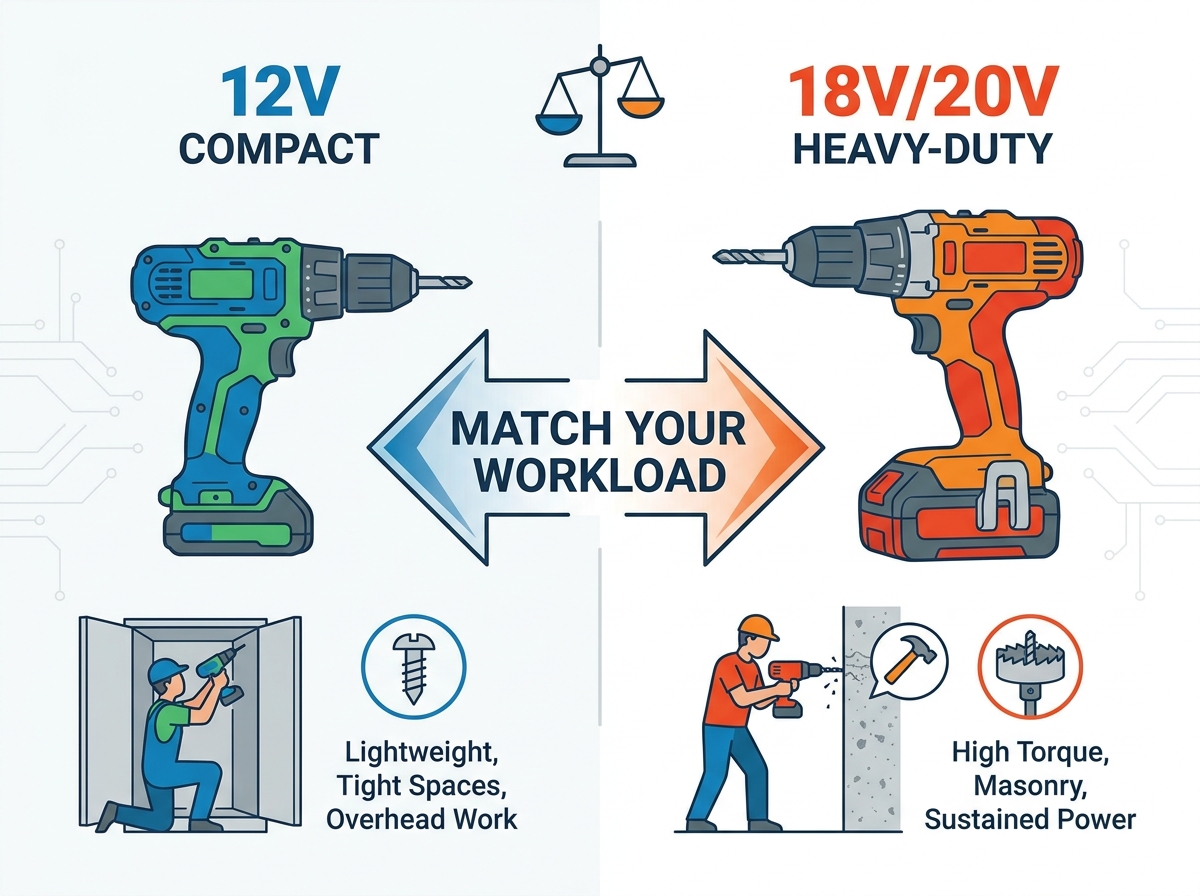
Choosing the correct voltage platform determines your daily efficiency. Many buyers misunderstand how battery voltage translates to physical work. The industry uses confusing terminology to market their platforms. You must understand these terms to buy the right tool.
Let us clarify a major marketing myth. You will frequently see tools labeled as "20V Max." You will see competing tools labeled as "18V." These represent the exact same power tier. The 20V Max label simply measures the peak voltage immediately after a fresh charge without a workload. Once the tool starts working, it drops to its nominal voltage of 18V. Do not base your buying decision on this deceptive labeling tactic.
Your typical workload dictates your ideal voltage. Use this straightforward framework:
Choose the 12V platform if: About 80% of your work involves driving standard fasteners. It is perfect for drilling into wood, drywall, and sheet metal. You prioritize low weight and maneuverability over brute strength.
Choose the 18V/20V platform if: Your success relies on driving heavy lag bolts. You frequently drill into aged concrete. You operate large hole saws daily. You need maximum sustained torque and do not mind the extra weight.
Buying a power tool rarely ends with a single purchase. You are entering a proprietary ecosystem. Each brand uses unique battery connections. A battery from one brand will not fit a tool from another. You must understand long-term expenses before making a choice.
Tool manufacturers employ a classic business strategy. They heavily discount the bare tool to get you into their ecosystem. Finding a cheap Lithium ion drill for sale is often a trap. The replacement proprietary batteries frequently cost more than the drill itself. You must calculate the cost of high-capacity replacement batteries before committing to any brand.
Amp-hours (Ah) measure the fuel tank capacity of your battery. Many entry-level drill bundles include tiny 1.5Ah or 2.0Ah batteries. A 2.0Ah battery will quickly fail a busy contractor. It drains fast during heavy applications like masonry drilling. This forces you to buy expensive 5.0Ah+ upgrades almost immediately. Always factor in the cost of high-capacity batteries when evaluating a cheap bundle deal.
You can protect your wallet by auditing a brand's specific warranty. Battery warranties often remain separate from the tool warranty. A tool might offer a five-year guarantee, while the battery only carries a one-year warranty.
Furthermore, review the brand's backward compatibility history. Trustworthy brands ensure their new batteries fit their ten-year-old tools. Avoid brands famous for constantly changing their battery interfaces. This practice forces you to replace perfectly good tools.
Selecting the right tool requires honesty about your daily tasks. Remind yourself to select a tool based on the heaviest task you perform frequently. Do not buy a massive hammer drill for a heavy task you perform only once a year. A compact tool serves you better for the other 364 days.
Your next steps involve auditing your current setup. Inventory your existing bare tools. Select your preferred voltage platform based on our 12V versus 18V framework. We highly recommend checking current seasonal bundles for the highest Amp-hour battery inclusions.
Every modern Lithium-ion Drill relies on its ecosystem. You must ensure the broader brand catalog meets your future needs. Take your time, compare battery replacement costs, and prioritize a brushless motor. Protect your Lithium-ion Drill investment by choosing a platform with a proven track record of backward compatibility.
A: Lithium-ion batteries typically last between 3 to 5 years. This translates to roughly 500 to 1,000 full charge cycles. Their exact lifespan depends heavily on heat exposure and depth of discharge. Leaving them in a hot truck degrades the cells rapidly. Frequent use actually helps maintain cell health better than leaving them dormant.
A: Yes. Amp-hours (Ah) dictate your runtime, not the voltage. Using a higher Ah battery remains completely safe. It acts like a larger fuel tank for your tool. It provides significantly longer life between charges. However, keep in mind it adds noticeable physical weight to the base.
A: Absolutely. We universally recommend brushless models for anyone using the tool weekly or professionally. They offer superior electrical efficiency and zero maintenance. Brushless motors run cooler, extending the life of internal components. You save money long-term through increased battery efficiency and fewer mechanical breakdowns.
A: Store your tool and batteries in a climate-controlled environment. Avoid freezing vehicles or baking-hot outdoor sheds. Extreme temperatures ruin battery chemistry. For long-term storage, keep the battery charged to around 50%. Storing them fully charged or completely dead stresses the internal cells and diminishes overall capacity.


