
Views: 0 Author: Site Editor Publish Time: 2025-11-17 Origin: Site


In modern agriculture, efficiency and precision are key to maintaining profitability and sustainability. Farmers are constantly searching for tools that simplify land management and reduce manual labor without compromising quality. Among these tools, the brush cutter stands out as one of the most versatile and powerful solutions for managing vegetation, maintaining landscapes, and preparing land for cultivation.
This article explores how brush cutters play a vital role in improving farm efficiency and land management, their main types, operational advantages, and practical applications.
A brush cutter is a motorized tool designed for cutting dense grass, weeds, small trees, and other vegetation that ordinary lawn mowers or trimmers cannot handle. It typically consists of a robust engine (either gasoline-powered or electric), a straight shaft, and a cutting head equipped with metal blades or nylon lines.
Unlike simple grass trimmers, brush cutters can handle thicker vegetation and uneven terrains, making them indispensable for agricultural and landscaping tasks. They are designed for durability, power, and adaptability—ideal for tough environments such as farms, orchards, roadside areas, and pasturelands.
Understanding the different types of brush cutters helps farmers select the right equipment for specific applications. Brush cutters come in various designs and power levels, depending on the scale of work and vegetation density.
These are compact and easy to maneuver, suitable for small farms, gardens, and orchard maintenance.
Advantages: Lightweight, easy to transport, suitable for narrow spaces.
Common Uses: Cutting tall grass around fences, irrigation ditches, or trees.
These feature an engine mounted on a backpack frame, with a flexible shaft connecting it to the cutting head.
Advantages: Reduces strain on the user’s arms, allowing longer operation periods.
Common Uses: Large-area grass cutting, hillside maintenance, and sloped terrain clearing.
These are more powerful and stable, ideal for clearing large fields or overgrown areas.
Advantages: Higher engine capacity, greater stability, and less fatigue for operators.
Common Uses: Land clearing, fallow field management, and roadside maintenance.
Some models can be fitted with different attachments (e.g., hedge trimmer, pole saw, tiller).
Advantages: Versatility—one machine serves multiple functions.
Common Uses: Farm boundary trimming, orchard pruning, and small-scale tilling.
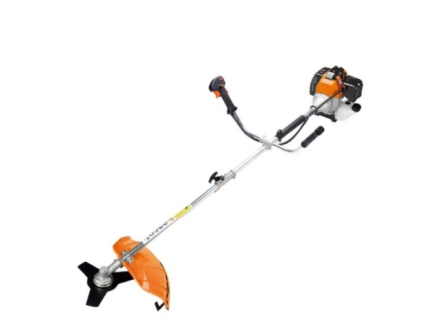
A well-chosen brush cutter can significantly boost productivity, reduce costs, and make land maintenance faster and easier. Below are the primary ways brush cutters improve efficiency on the farm.
Traditional land clearing with hand tools like sickles or machetes is time-consuming and labor-intensive. Brush cutters can accomplish the same work in a fraction of the time.
For example, clearing one hectare of overgrown weeds manually might take days, but with a high-power brush cutter, it can be completed within hours.
This time savings allows farmers to focus on more value-added tasks such as planting, irrigation, and crop management.
Brush cutters help cut costs in several ways:
Reduced labor needs: One operator can cover a large area efficiently.
Lower fuel and equipment costs: Compared to tractors or heavy mowers, brush cutters consume less fuel and are cheaper to maintain.
Less equipment wear: Regular trimming prevents vegetation from becoming too thick, reducing the need for expensive land-clearing machinery later.
Uncontrolled weeds compete with crops for nutrients, water, and sunlight. Regular cutting using brush cutters keeps weeds under control, allowing soil nutrients to be directed toward productive plants.
Moreover, brush cutting reduces the need for chemical herbicides, supporting eco-friendly farming practices.
Brush cutters are suitable for multiple terrains—flat, sloped, rocky, or wetland areas. They can be used in:
Orchard maintenance (removing weeds around fruit trees)
Pathway clearing (keeping access routes open)
Fence line cleaning (preventing damage from overgrowth)
Drainage ditch maintenance (improving water flow)
This adaptability makes brush cutters essential tools for comprehensive land management.
Overgrown grass and brush can hide hazards such as snakes, sharp stones, or uneven ground. Regular cutting ensures better visibility and reduces risks for workers and livestock.
Additionally, brush cutting improves access for machinery like tractors and irrigation systems, supporting smoother farm operations.
Technological improvements have made today’s brush cutters more efficient, safer, and easier to operate than ever before.
Modern brush cutters are equipped with 2-stroke or 4-stroke engines that deliver consistent torque and cutting power. Four-stroke engines, in particular, are quieter and more fuel-efficient, reducing operator fatigue and environmental impact.
Manufacturers now focus on comfort and usability. Features like anti-vibration handles, adjustable shoulder straps, and balanced weight distribution help operators work for longer periods without strain.
Depending on the task, users can switch between nylon cutting heads for grass and metal blades for thick shrubs or small trees. This versatility enhances operational flexibility across different areas of the farm.
Quick-access air filters, detachable shafts, and simplified carburetor systems make modern brush cutters easier to maintain. Regular cleaning and servicing ensure long-term performance with minimal downtime.
Newer models are designed to reduce fuel consumption and emissions, aligning with sustainable agriculture goals. Battery-powered and hybrid brush cutters are also emerging as environmentally friendly alternatives.
To maximize efficiency and safety, it’s important to follow proper operating practices and maintenance routines.
Before starting, always inspect the brush cutter:
Ensure blades are sharp and securely fastened.
Check fuel levels and oil.
Confirm that the safety guard is properly installed.
Wear protective gear: gloves, goggles, boots, and ear protection.
Correct Operation Techniques
Maintain a firm grip on both handles.
Keep the cutting head parallel to the ground.
Avoid forcing the machine—let the blade do the work.
Clear the area of stones, wires, or debris that may damage the blade.
After each use:
Clean the air filter and cutting head.
Check for loose bolts or fuel leaks.
Lubricate moving parts.
Store in a dry, shaded area to prevent corrosion.
Never operate near people or animals.
Avoid working in wet conditions to prevent slipping.
Stop the engine immediately if abnormal vibration occurs.
Follow manufacturer guidelines for blade replacement and fuel mixing ratios.
While brush cutters are primarily associated with agricultural use, their practicality extends to other sectors as well.
Homeowners and professional landscapers use brush cutters for trimming overgrown gardens, clearing flowerbeds, and shaping hedges.
Brush cutters help clear undergrowth and small trees, reducing the risk of forest fires and promoting healthy forest regeneration.
Municipal workers use brush cutters to maintain road shoulders, parks, and riverbanks—keeping these areas neat, safe, and accessible.
Before new construction begins, brush cutters efficiently clear land of vegetation, ensuring clean, manageable sites for builders and surveyors.
When selecting a brush cutter, consider the following factors to ensure optimal performance:
Factor | Recommendation |
Power Type | Gasoline for large-scale farms; electric or battery for small areas |
Engine Capacity | 25cc–35cc for light use; 40cc–60cc for heavy-duty work |
Cutting Width | Larger widths increase productivity on open land |
Blade Type | Nylon for grass; metal for brush and saplings |
Weight & Balance | Choose ergonomic models with good weight distribution |
Ease of Maintenance | Models with accessible air filters and detachable shafts |
Brand & Warranty | Trusted manufacturers with reliable after-sales service |
Selecting the right brush cutter ensures better performance, longer lifespan, and reduced fatigue during operation.
As agricultural technology advances, brush cutters are evolving to become more efficient and environmentally friendly.
Emerging innovations include:
Battery-powered brush cutters with longer runtimes and zero emissions.
Smart control systems for automatic speed adjustment based on vegetation density.
Lightweight composite materials to reduce operator strain.
Noise-reduction technology for quieter operation near residential areas.
These developments indicate that the brush cutter will remain a critical tool for sustainable land management.
Efficient land management is the backbone of successful farming, and the brush cutter has proven to be an indispensable tool for this purpose. From clearing dense brush to maintaining field boundaries, it saves time, reduces labor, and supports sustainable agricultural practices. Its versatility makes it equally useful for farms, orchards, public maintenance, and landscaping projects.
If you’re looking for reliable, durable, and high-performance brush cutters designed to meet both small-scale and large-scale needs, consider exploring the range offered by [Ningbo Yangyi Import and Export Co., Ltd.].
This trusted company provides various models engineered for strength, efficiency, and operator comfort—ideal for farmers, landscapers, and contractors worldwide. To learn more about their brush cutter solutions or to get expert recommendations, visit Ningbo Yangyi Import and Export Co., Ltd. today.


